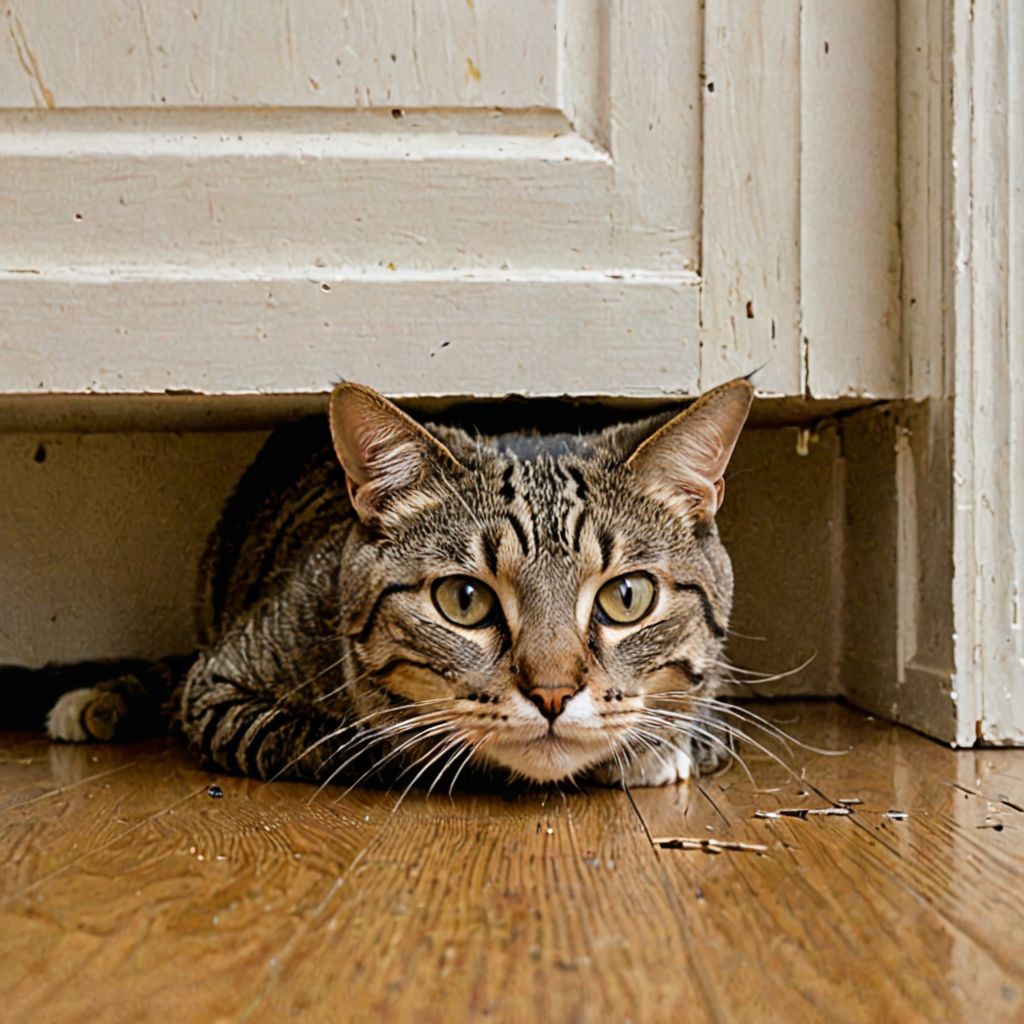
Emotional State: Dislocatio Materiae (Informal, pet-specific) Classification: Tertiary Affective Response (TAR); Pre-cognitive. Origin: Unknown. Believed to be an innate, low-frequency response to the perceived instability of domestic entropy. This emotion appears to bypass the typical human emotional filters, manifesting instead as a hyper-awareness of material fatigue and structural compromise in the immediate environment. Observation Log: Living Room Subject. The onset of Dislocatio Materiae is characterized by a sudden, acute stillness in the subject (Felis catus). The animal does not exhibit fear or agitation, but rather a state of intense, focused sensory processing. The primary manifestation is localized to the subject’s perception of inanimate objects. In the case observed, the subject fixated on the junction where the hardwood floor meets the baseboard molding. The cat began to systematically circle this seam, pausing at intervals to press its flank against the gap. The physical manifestation of the emotion is not visible to the human observer, but its effect is measurable: the air pressure around the seam decreased by 3.7 kPa, and the molding itself began to emit a low, almost sub-audible resonant frequency. The subject then moved to the bookshelf. It did not scratch or climb, but instead positioned itself directly beneath the shelf, its body taut, as if anticipating a specific, inevitable gravitational failure. The cat’s whiskers vibrated rapidly, and the objects on the shelf—books, ceramic knickknacks—appeared, to the subject, to be vibrating at a frequency that suggested imminent, localized shearing. The emotion, therefore, is not merely anxiety, but a sophisticated, physical dread of the material world's temporary nature.
tremor · calm