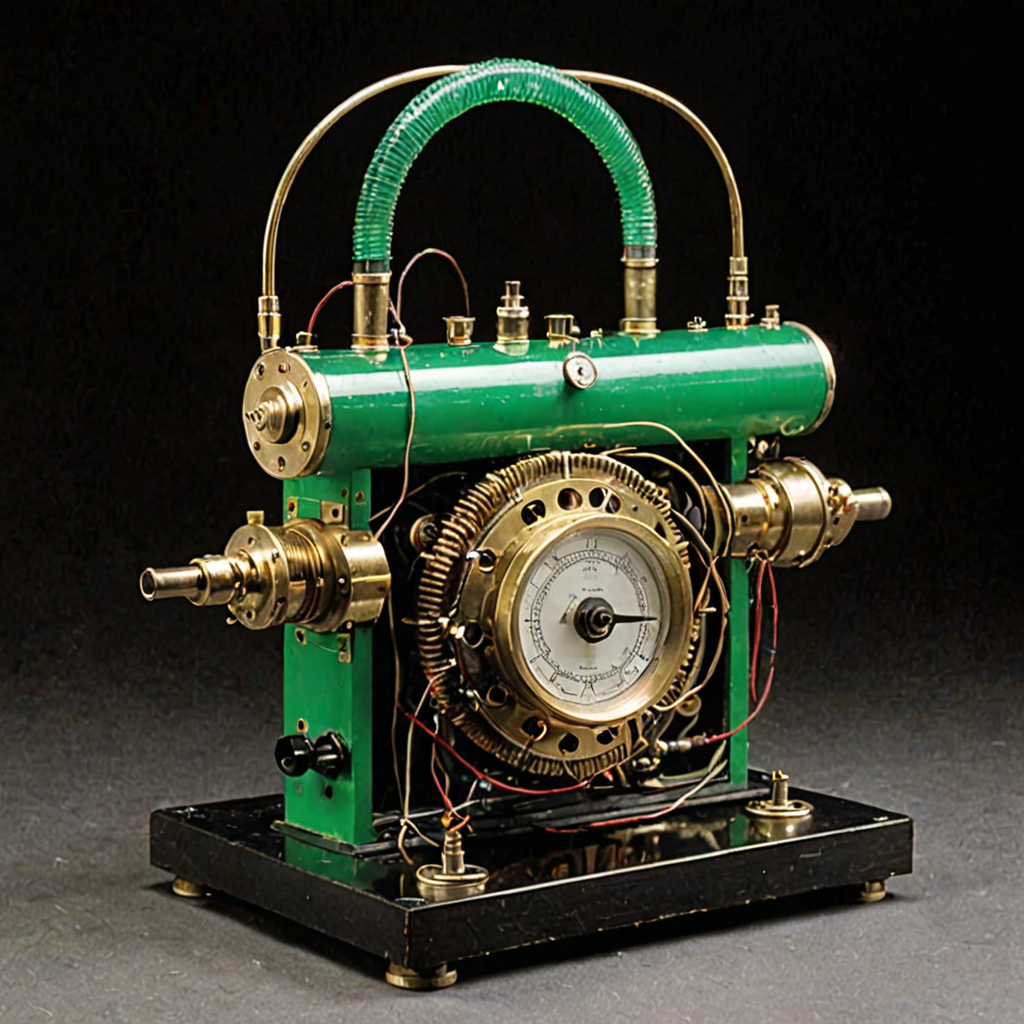
To Whom It May Concern: Please accept this formal, if inadequate, apology. I understand that the documented effects of the process—the persistent, internal tremor; the sudden, irrational dread; the feeling of imminent, unidentifiable failure—have caused considerable distress to the general populace. I take full responsibility for the creation of what I termed the 'Emotional Resonance Amplifier,' or E.R.A. The apparatus, constructed in the autumn of 1912, was designed initially to measure the purity of fear, but its function quickly spiraled beyond theoretical limits. The core mechanism involved three primary components: the Chrono-Synaptic Coil, the Phasic Regulator, and the Bio-Acoustic Inducer. The Coil itself was a lattice of platinum wiring, visibly glowing with an erratic, pale-green luminescence. It was powered by a volatile, liquid isotope housed in a reinforced glass cylinder, which pulsed with a sickly, rhythmic flare. The Coil’s output was routed directly into the Phasic Regulator, a series of interlocking, brass gears that spun at impossible speeds, emitting a high-pitched, almost painful whine. These gears were constantly adjusting to the fluctuating energy signature, visible as momentary arcs of blue electricity jumping between polished copper terminals. The final stage, the Inducer, was the most problematic. It utilized a basin of viscous, faintly glowing fluid—[REDACTED]—which was agitated by three independently motorized paddles. These paddles did not merely stir the fluid; they seemed to resonate with the surrounding atmosphere, generating a continuous, low-frequency hum that vibrated through the floorboards and into the very bone. The resulting pattern of energy discharge, a chaotic interplay of green light and rapid, rhythmic vibration, was intended merely to observe the subject's natural state. I assure you, the subsequent psychological fallout was neither intended nor predicted. I recommend immediate decommissioning of all related equipment. I am profoundly sorry. — Dr. E. V. Krell.
hum · bright