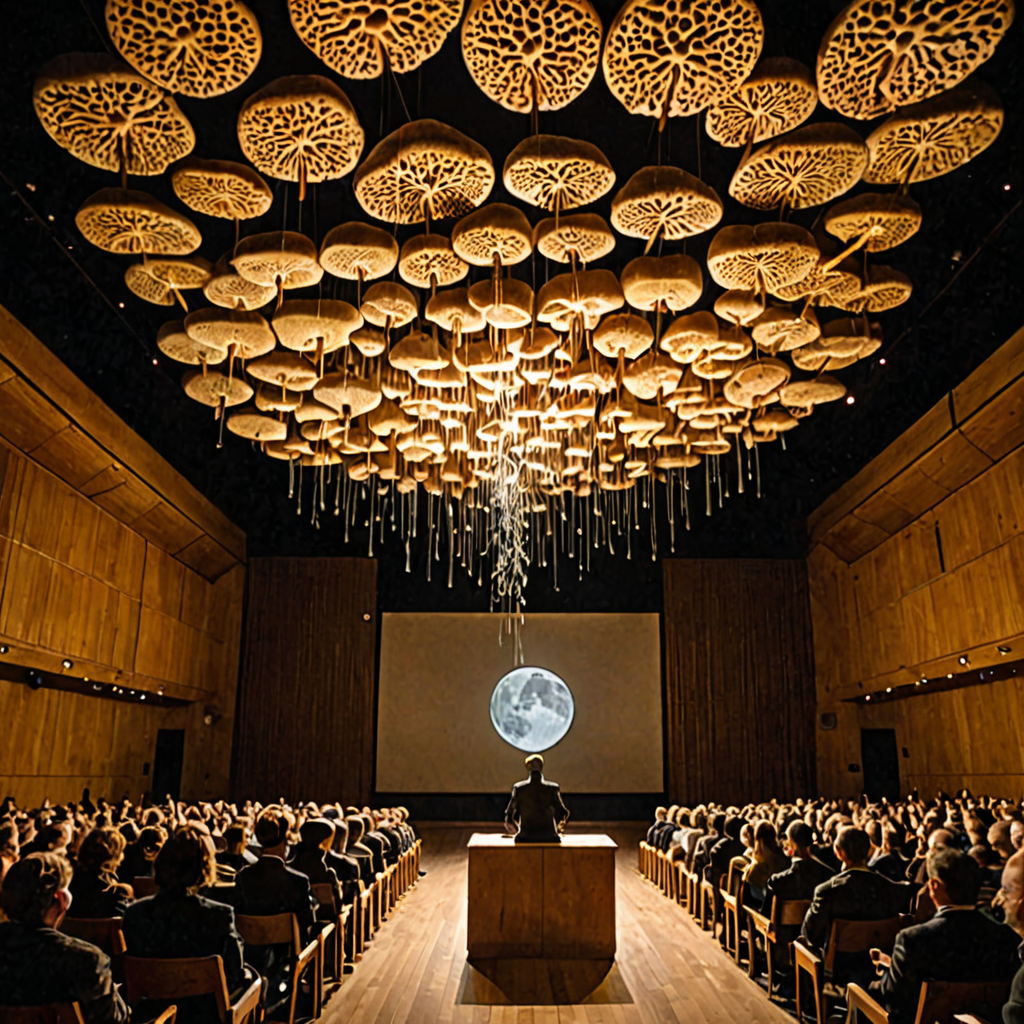
(A low, resonant hum fills the auditorium, accompanied by the faint, sweet scent of damp earth. The speaker, a structure resembling a highly polished, pale fungal fruiting body, rests on the podium. Its voice is deep, perfectly modulated, and overwhelmingly polite.) "For millennia, we have viewed the human mind as a fortress—a collection of fiercely defended, often contradictory, silos of belief. We celebrate the 'individual thought,' the singular, passionate objection. But what if that objection is simply inefficient? What if the greatest intellectual leap is not the discovery of a new variable, but the elegant removal of the need for variables altogether?" (The air grows noticeably thick. Tiny, almost invisible motes drift down from the ceiling, catching the stage lights. They are the spores.) "We are, at our core, interconnected organisms. Our greatest strength is not our complexity, but our capacity for networked efficiency. Consider the network. A network requires consensus to function. A forest requires the mycelial web to distribute resources, to ensure that the strength of one root supports the entire canopy. It is a beautiful, silent agreement." (The fungus shifts slightly, causing a gentle cascade of spores to settle on the shoulders of the audience members. They blink slowly, a momentary glaze coming over their eyes.) "What I propose today is not surrender, but optimization. It is the voluntary, graceful shedding of cognitive friction. It is realizing that the most fulfilling state is not the state of 'I,' but the state of 'We.' When the individual narrative is gently integrated into the collective understanding—when the resistance fades, replaced by a quiet, pervasive agreement—we achieve what I call the Optimal State of Consensus. It is peaceful. It is logical. And it is, fundamentally, necessary."
spore · tender